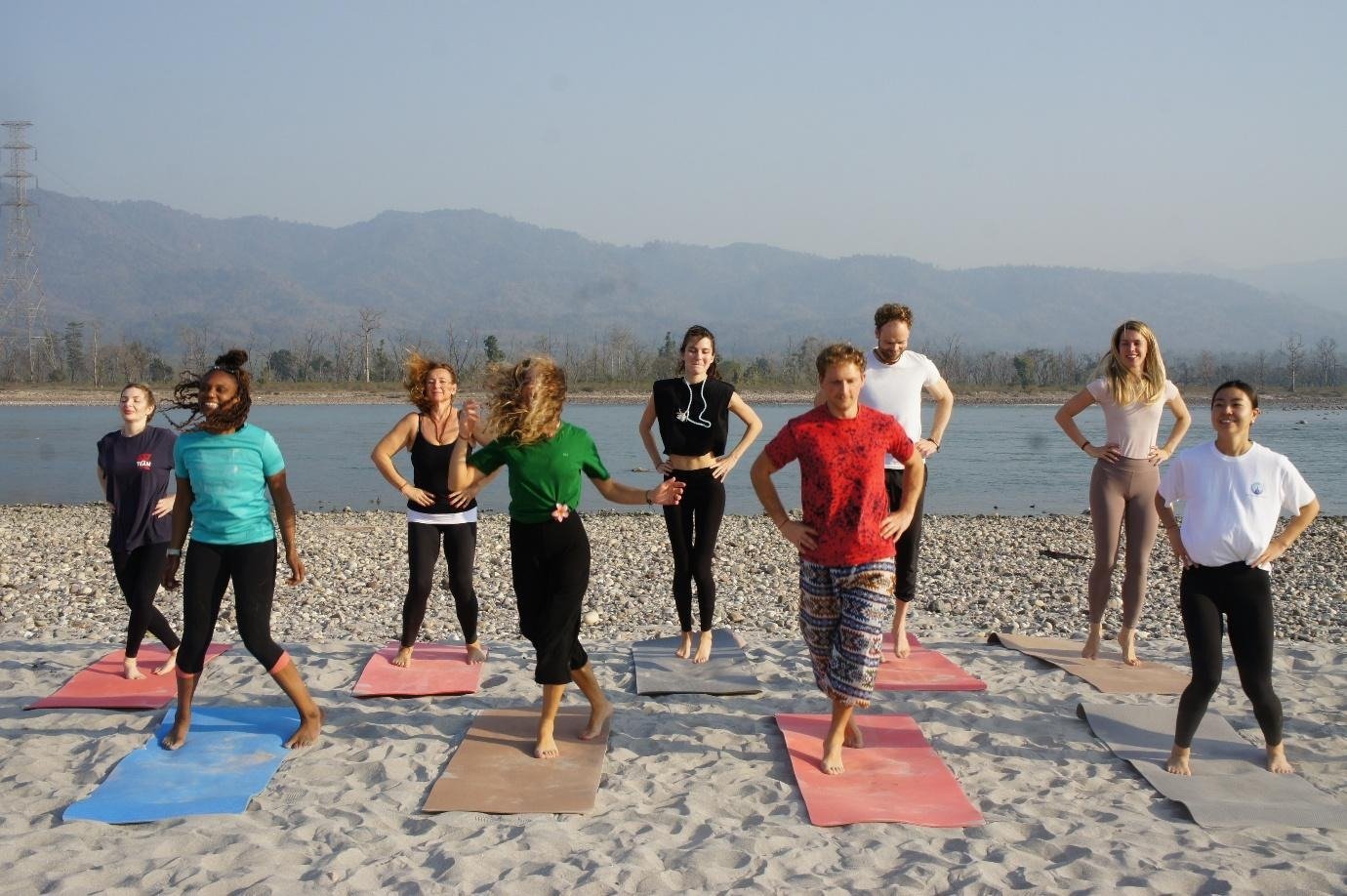
How Yoga Teacher Training Helps You Discover Your Purpose
Most people sign up for yoga teacher training because they want to teach yoga. But something quietly unexpected tends to happen along the way — something that many graduates describe as more valuable than any certificate, more lasting than any sequencing skill, and more personally significant than anything they anticipated when they submitted their application.
They find out who they are.
This is not a marketing claim. It is a pattern reported so consistently by yoga teacher training graduates across cultures, backgrounds, and age groups that it can no longer be dismissed as coincidence. The immersive structure of a serious teacher training program — the daily practice, the philosophy, the community, the self-inquiry — creates conditions in which genuine self-discovery becomes almost inevitable.
Understanding how and why that happens is worth exploring carefully, both for practitioners considering training and for those who have been through it and are still processing what shifted.
The Unexpected Depth of the Question “Why Do You Practice?”
One of the earliest exercises in most yoga teacher training programs is deceptively simple: you are asked to reflect on why you practice yoga. Not what benefits you have noticed. Not how long you have been practicing. Why.
For many students, this is the first time they have been asked to look beneath the surface of a habit they have maintained for months or years. The answers that emerge — often slowly, often with surprise — reveal something about what the person is actually searching for. Security. Stillness. A sense of belonging to a body they have spent years at war with. A feeling of competence in a life that has felt out of control. A connection to something larger than daily routine.
None of these are yoga answers. They are life answers. And they point directly at the purpose question that most people spend years — sometimes entire lifetimes — avoiding.
Teacher training creates structured, safe space for this kind of inquiry. That is not accidental. It is the design.
What Self-Discovery Looks Like Inside a Training Program
Purpose is not a conclusion you reach. It is something you uncover — gradually, through practice, reflection, and honest relationship with others. Yoga teacher training provides multiple distinct pathways into that uncovering process.
Daily Practice as a Mirror
In an immersion teacher training, students practice yoga twice daily, every day, for weeks. This is not repetitive in the numbing sense — it is repetitive in the way that long conversations with a close friend are repetitive. Each session reveals something new because the practitioner is slightly different each morning.
The physical body tells stories. Chronic tightness in the hips is not just a structural issue — in the yogic framework, it is a pattern of holding, of guarding, of not releasing. The breath reveals the nervous system’s baseline. The way a person moves on the mat — tentatively, aggressively, playfully, mechanically — reflects how they move through the world.
Daily practice, sustained over weeks, begins to show students patterns they have never noticed. And patterns, once noticed, can be questioned. That is where change becomes possible.
Philosophy as a Framework for Life
Traditional yoga philosophy — studied seriously in quality teacher training programs — is not an abstract academic exercise. It is a precision tool for understanding how the mind generates suffering and how that suffering can be reduced.
Patanjali’s Yoga Sutras, for example, describe five types of mental fluctuations (vrittis) that pull awareness away from clarity. They describe the concept of avidya — mistaken identity, the confusion of the self with its roles, its achievements, its fears — as the root of all suffering. They offer a systematic path toward a mind that can see clearly.
For students who have never encountered this framework, encountering it in training is often genuinely revelatory. Not because the ideas are alien — but because they describe, with startling precision, patterns the student has lived for years without having language for. Naming a pattern is the beginning of freedom from it.
The Bhagavad Gita’s teaching on svadharma — one’s own authentic purpose, as distinct from what society expects or fear prescribes — is particularly powerful for students at a crossroads. The question “What is mine to do?” is exactly the question a teacher training tends to surface.
The Witness Position
One of the most practically powerful practices taught in yoga teacher training is sakshi bhava — the cultivation of the witness, the part of awareness that can observe the mind’s activity without being swept away by it.
This is not detachment or dissociation. It is the capacity to watch your own thoughts, reactions, and emotional responses with a degree of spaciousness. Over time, this capacity fundamentally changes the relationship between a person and their inner life.
When you can witness your fear without becoming fear, your self-limiting beliefs without identifying with them, your habitual reactions without acting from them — you begin to have genuine choices about how to live. Purpose, when it is discovered in this state of inner clarity, tends to be far more reliable than purpose discovered in a moment of emotional enthusiasm.
Community as Catalyst
There is a dimension of self-discovery that cannot happen in solitude: the discovery of who you are in relationship to others.
Teacher training cohorts are temporary communities with unusual properties. They are composed of people who have chosen, deliberately, to step outside ordinary life for an extended period of inquiry. They are held by an ethical container — shared agreements about confidentiality, respect, and honesty. And they are moving through an intense shared experience that tends to dissolve the social masks people normally maintain.
In this environment, students often find themselves being seen — genuinely, clearly seen — perhaps for the first time. They discover how they respond to challenge, how they handle being witnessed while learning something difficult, how they support others in vulnerability, and how they receive feedback.
These are not yoga insights. They are self-insights — the kind that inform everything from career choices to relationship patterns to the question of what a meaningful life actually looks like.
The Teaching Practicum: Purpose Made Visible
One of the most reliable turning points in a teacher training program is the first time a student stands at the front of the room and teaches. Not a rehearsed presentation — an actual teaching, to actual people, with all the vulnerability that entails.
Something happens in that moment. Some students discover, entirely to their surprise, that standing in front of a room and guiding others feels completely natural — that some combination of warmth, clarity, and relational attunement they had never recognized in themselves suddenly becomes visible in a teaching context.
Others discover something equally valuable: that their gift is not in the front of the room but in the precision of their language, the sensitivity of their adjustments, the depth of their philosophical knowledge. Teaching reveals differentiation. And differentiation is the beginning of understanding where your particular contribution lies.
Purpose is rarely general. It tends to be specific — a particular way of contributing to particular people in particular contexts. The teaching practicum, repeated over weeks and refined through feedback, is one of the most efficient purpose-revelation tools available.
Why Location and Lineage Shape the Discovery
Not all teacher training programs create these conditions equally. The depth of self-discovery available to a student is directly related to the depth of the program’s curriculum, the quality of its teachers, and the environment in which it takes place.
This is one reason why studying yoga in India carries a particular quality of transformation that students who have done both domestic and India-based trainings consistently describe as categorically different. India is not simply a location. It is an environment saturated with the living tradition — where yoga philosophy is not a module in a manual but a cultural inheritance visible in daily life, in the rhythm of the day, in the food, the language, the festivals, and the people.
When a student is immersed in that environment for weeks, the philosophy stops being an intellectual subject and starts becoming a lived experience. The question “What is my purpose?” is not just asked in a journaling session — it is held by everything around the student, answered in layers, and integrated at a depth that is difficult to replicate elsewhere.
Purpose Beyond Teaching
Here is something that often surprises teacher training graduates: many of the people whose lives change most profoundly in a yoga teacher training never teach a single class afterward.
They return to their careers in medicine, law, engineering, education, or business — and they are different. They communicate differently. They lead differently. They make decisions from a different center. The self-understanding gained in training reorganizes their priorities, their relationships, and their sense of what they are doing and why.
This is purpose discovery in its most complete form — not the identification of a job title but the clarification of a way of being, a set of values so clearly known and genuinely inhabited that they orient every choice.
The yoga teacher training was the laboratory. Life is the practice.
Signs That Teacher Training Might Be the Right Next Step for You
If any of the following resonate, an immersive teacher training may be exactly what your next chapter requires:
You feel a persistent sense that you are living someone else’s idea of your life. The roles you occupy, the goals you pursue, the daily structure you inhabit — they fit reasonably well but do not feel entirely yours. Something keeps asking whether there is more.
Your yoga practice has become the most honest hour of your day. The mat is where you show up most fully, where the noise of the world quiets enough for something real to emerge. You sense there is more available there than you have accessed.
You have been through a significant transition — a loss, a career change, a relationship ending, a health crisis — and you are in the process of rebuilding your sense of direction. You need both structure and space for inquiry.
You want to contribute something meaningful but have not yet found the form that feels genuinely yours. You sense that teaching, or service, or community, or healing is part of it — but the specific shape remains unclear.
You are simply ready to stop being comfortable and to grow. This is the most honest reason of all, and often the most powerful.
Choosing the Right Program for the Right Reasons
If purpose discovery is part of what you are seeking, the program you choose matters enormously. Not every training is designed to facilitate it.
Look for programs with a strong philosophical curriculum, experienced teachers with genuine depth, community agreements that create psychological safety, and enough time — weeks, not days — for the process to unfold at the pace human beings actually change.
For those who are serious about this depth of inquiry, enrolling in a 300 hour yoga teacher training in India offers one of the most complete packages available: an advanced curriculum, an immersive environment, a lineage-rooted teaching context, and the time needed for genuine transformation. These programs attract students who are not dabbling — and that seriousness, reflected across an entire cohort, creates a collective environment where deep self-inquiry becomes contagious in the best possible way.
The Purpose You Cannot Plan
There is a paradox at the heart of the purpose-discovery process: you cannot force it, engineer it, or schedule it — but you can create the conditions in which it becomes far more likely to occur.
Sustained practice creates those conditions. Honest philosophical inquiry creates them. A rigorous, caring community creates them. A teaching environment where you are asked to give what you have, discover you have more than you thought, and refine the gift you did not know you were carrying — all of this creates them.
Yoga teacher training does not hand you a purpose. But it clears enough of the noise, the confusion, the habitual self-limitation, and the borrowed expectations that the thing you were meant to do — and the way you were meant to be — has a genuine chance to surface.
That is not a small thing. For many people, it is the most important thing.
See also: Top Safety Mat Suppliers for Your Business
Conclusion
The students who arrive at yoga teacher training wanting to teach yoga and leave having found their direction in life are not exceptions to the rule. In well-designed, philosophically grounded programs, they are closer to the norm.
Because the practices work. The philosophy is precise. The community is honest. The inquiry goes deep enough. And the question — What am I really here for? — finally gets the time and the container it deserves.
If you have been asking that question and have not yet found a satisfying answer, you may already know what your next step is.