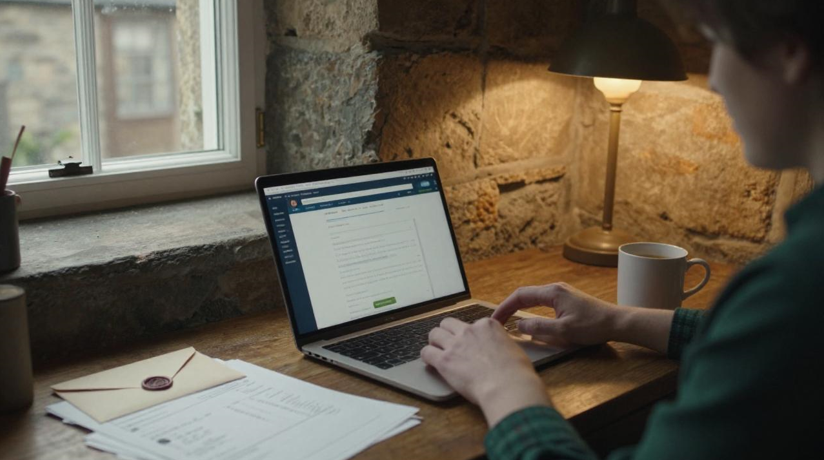
Small UK Businesses Are Quietly Losing Credibility Over Their Email Address
For a small British firm, the sender line is often the first impression a client gets.
There’s a small ritual most British entrepreneurs know well: the moment a side project stops being a hobby and starts being a business. It usually involves registering with Companies House, opening a business bank account, printing the first invoices, and telling HMRC the news.
And then, on those invoices and that shiny new website, sits the same Gmail address the founder has had since university.
It’s a remarkably common pattern among Britain’s five-and-a-half million small businesses, from the Ealing consultancy billing four days a week to the Cornwall candle maker shipping nationwide to the Manchester content agency landing its first retainer. The business is real, registered, and insured. The email, though, is a free consumer account with a awkward handle and a birthday in its password history.
What the sender line says before you say anything
British buyers, whether consumers or procurement managers, read sender lines faster than they read anything else in an email. It’s not snobbery; it’s shorthand. In a country where trust in digital communication has taken a battering from years of scam calls, fraud texts, and phishing waves impersonating everything from Royal Mail delivery fees to HMRC rebates, the sender line is the first security check everyone performs, consciously or not.
Now consider the asymmetry: when a customer receives an invoice notification from accounts@yourbusiness.co.uk, the brain files it under “company correspondence.” When the same invoice arrives from jsimpson1988@gmail.com, the brain hesitates, is this the supplier, or someone who has spoofed them? That hesitation, multiplied across every customer, supplier, and bank contact, is a quiet drag on a small business’s professional standing.
A custom email domain resolves it cleanly. The address and the business share a name, and every piece of correspondence inherits the credibility of both. The infrastructure costs a few pounds a month, less than the domain you may already be paying for.
The privacy reckoning British businesses have already had
There’s a second argument, and it’s distinctly British: GDPR. Since the UK adopted its own version of the General Data Protection Regulation, every business that handles personal data, which is to say, effectively every business with a customer list, carries legal obligations around how that data is processed.
Most owners think of GDPR in terms of databases and consent forms. Fewer consider the mailbox. Yet where does customer personal data actually concentrate in a small business? Correspondence containing names, addresses, order details, invoice histories, supplier negotiations, and bank details, all of it lives in email, often as the only record.
The mainstream free email providers operate on an advertising model under which message contents are analysed for profiling. For a UK business owner, that means the customer correspondence you’re entrusted with is being commercially processed in ways you never stipulated, by a provider your customers never chose. Whether that sits comfortably with the spirit of data protection by design is a question worth asking, and one that the Information Commissioner’s Office has raised about ad-funded data processing more broadly.
Encrypted email providers offer a structurally different arrangement: with end-to-end encryption, the provider cannot read the contents of messages between its users. Customer details, supplier terms, and contract negotiations remain between the parties, which is what customers assume is happening anyway.
Domain ownership as a business asset
Beyond credibility and compliance, there’s a simpler commercial point: the domain is yours. A business that runs on a borrowed consumer address builds years of correspondence history, customer recognition, and account recovery pathways on infrastructure it doesn’t own. If that account is ever locked, hijacked, or suspended, and recovery from a free account depends entirely on the provider’s goodwill and an automated appeal queue, the business loses its operational memory at a stroke.
With your own domain, the reverse holds. The addresses are yours; the mail provider is a supplier like any other, and suppliers can be changed without losing the asset. Every invoice sent, every customer relationship built, and every bank linkage established accrues to the domain, a transferable component of the business’s goodwill if you ever sell it.
Getting set up: an afternoon’s work
For a business that already owns a domain (and most with a website do), the migration is refreshingly small:
- Check your domain registrar. Whose personal email is listed as the registrant contact? If it’s a personal consumer account, that’s the first vulnerability to fix, DNS hijacking starts at the registrar, and the registrar reset link goes to that mailbox.
- Plan your addresses by function. A sensible UK small-business starter set: hello@ or info@ for enquiries, accounts@ for invoicing, orders@ if you fulfil anything, and a personal name@ for relationship correspondence. Avoid role confusion: customers remember names, suppliers remember functions.
- Choose a provider that matches your obligations. An encrypted business plan gives you the custom domain, end-to-end encryption, and administrative separation between accounts, worth weighing against the mainstream options whose business tiers don’t change the underlying analysis-based model.
- Update your critical anchor points first, bank and accountant correspondence, Companies House records, HMRC, insurers, and payment processors.
- Update the public surface, website contact details, invoice templates, email footers, social media bios, and marketplace listings.
- Forward the old address for two full billing cycles. Every customer and supplier who has the old address saved will keep using it for longer than you expect; the bridge catches them.
See also: How to Advertise a Business on a Budget: Tips for Small Businesses
Small details, British businesses, and the long game
Britain’s small business culture has a long tradition of getting the details right, the carefully lettered shopfront, the properly folded invoice, the considered reply. Those details signal seriousness in a way slogans never quite manage.
The email address is this era’s version of that signal. It appears on every invoice, every quote, every enquiry reply, and every first impression your business makes. Getting it right costs a few pounds a month and one focused afternoon. Leaving it wrong costs a little credibility, a little compliance comfort, and occasionally, when a customer pauses at that jsimpson1988 sender line, a sale that never announces itself.
The shopfront rule applies online as much as on the high street: look like what you are. If you’re a business, be reachable at your own name.